Dec 8, 2025
·
Landscape
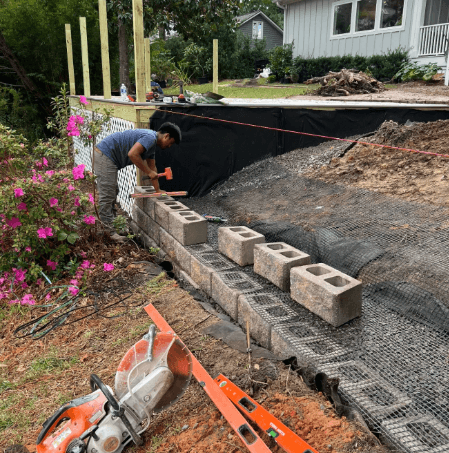
Top 10 Reasons Retaining Walls Fail (Charleston Edition)
What homeowners need to know before building or repairing a wall.
Retaining walls are one of the most common structural features in Charleston backyards — especially in neighborhoods with elevation changes, raised patios, or sloped yards. When they’re built correctly, retaining walls can last decades. When they’re built incorrectly, they can fail in as little as a few months.
The problem?
Most retaining wall failures come from the same exact mistakes, and almost all of them are avoidable with proper design and installation.
Here are the top 10 reasons retaining walls fail, and what Charleston homeowners should know before building or repairing one.
1. Poor Drainage Behind the Wall
This is the #1 cause of retaining wall failure — not even close.
When water builds up behind a wall, it creates hydrostatic pressure, which pushes the wall outward until it cracks, bulges, or collapses.
Signs of bad drainage:
bowing or bulging blocks
wall leaning forward
water seeping through joints
soil spilling over the top
A proper retaining wall must include:
perforated drainpipe
clean 57 stone backfill
weep holes (if needed)
proper grading to move water away
No drainage = guaranteed failure.
2. Not Enough Base or Compaction
A strong retaining wall starts at the bottom, not the top.
If the base layer isn’t deep enough — or isn’t compacted properly — the entire wall will eventually move.
Charleston’s sandy, shifting soil makes this even worse.
A correct base:
is dug deeper than you think (usually 6–12")
uses compacted 57 stone
sits on geotextile fabric in some cases
must be perfectly level
If the bottom isn’t solid, the whole wall becomes unstable.
3. No Geogrid (Reinforcement)
Walls over 3–4 feet tall NEED geogrid.
There’s no way around it.
Geogrid is a heavy-duty mesh material placed in layers behind the wall, anchoring it into the hillside.
Without it:
tall walls lean
soil pushes forward
gravity pulls the wall apart
If your wall is tall and has no geogrid, failure is only a matter of time.
4. Building with the Wrong Materials
Not all blocks or stones are meant for retaining walls.
In Charleston, we see homeowners try to use:
loose stacked stones
garden edging blocks
wood (which rots in humidity)
railroad ties
decorative bricks
These are NOT structural retaining wall systems.
Real retaining wall blocks are:
heavy
engineered
designed to lock together
meant to handle soil pressure
Cheaper materials = expensive repairs later.
5. Incorrect Wall Batter (No Backward Lean)
Retaining walls must lean slightly backward into the soil they're holding.
This is called “batter.”
A wall built perfectly vertical will eventually tip forward.
A proper wall usually leans:
1" back per foot of height
OR follows the manufacturer’s exact specs
This compensates for soil pressure and gravity.
6. Not Enough Burial Depth
A general rule:
10% of the wall height must be buried below grade.
If the wall is 4 feet tall, almost 5 inches should be underground.
Why?
The buried portion acts like a foundation, preventing:
sliding
forward leaning
frost heave (less of an issue here but still matters)
Many DIY or cheap-contractor walls are built “on top of the ground.”
These walls fail fast.
7. Poor Backfill Material
Backfill is just as important as the wall itself.
Using the wrong material (like dirt or clay) increases pressure dramatically.
Backfill must allow water to drain — not trap it.
Proper backfill layers include:
57 stone for drainage
compacted lifts of gravel or crushed stone
NO clay soil
NO topsoil
Using the wrong backfill guarantees movement and water pressure.
8. Lack of Proper Footing in Charleston's Sandy Soil
Charleston’s coastal soil is:
sandy
loose
often disturbed by builders
highly prone to settling
This means walls need:
deeper excavation
proper stone base
compaction in layers
sometimes geotextile stabilization
A wall built like one in the Midwest will fail here.
9. Walls Too Close to Property Lines or Structures
Retaining walls need space to function.
When built too close to:
fences
foundations
AC units
property lines
…they can’t drain or move naturally.
Some walls end up holding weight they weren’t designed for, which accelerates failure.
Proper setbacks often prevent this.
10. Lack of Professional Engineering for Tall or Load-Bearing Walls
Some walls simply require an engineer.
If your wall:
is over 4 feet tall
supports a driveway
holds up a patio
is near a structure
carries extra load (cars, decks, etc.)
…it must be engineered to meet safety standards.
Skipping engineering on these walls can lead to catastrophic collapse — especially after Charleston storms.
Bonus: Why Retaining Walls Fail Faster in Charleston
Charleston adds extra stress due to:
heavy rainfall
soil saturation
hurricanes
high humidity
shifting coastal soil
steep grades in neighborhoods like Mt. Pleasant, Daniel Island, Johns Island
This makes proper drainage + structural reinforcement essential.
How to Prevent Retaining Wall Failure
A long-lasting retaining wall MUST include:
a deep base of compacted 57 stone
drainage pipe
57 stone backfill
geogrid for taller walls
correct block choice
proper wall batter
professional design
correct burial depth
a stable foundation in sandy soil
If even one of these steps is skipped, the lifespan of the wall drops dramatically.
Final Thoughts
Retaining walls don’t fail because they're “old.”
They fail because they weren’t designed or built the right way.
If your wall is leaning, cracking, bulging, or showing early signs of stress, the sooner you address it, the less expensive it is to fix.
If you’re building a new wall, investing in proper design and drainage up front will save thousands over the long term.
Need a Retaining Wall Designed or Repaired in Charleston?
At No Pressure Contracting, we build drainage-first, engineer-level walls designed for Charleston’s climate — and built to last.
📲 Text or call 845-300-5088 to schedule a consultation.